
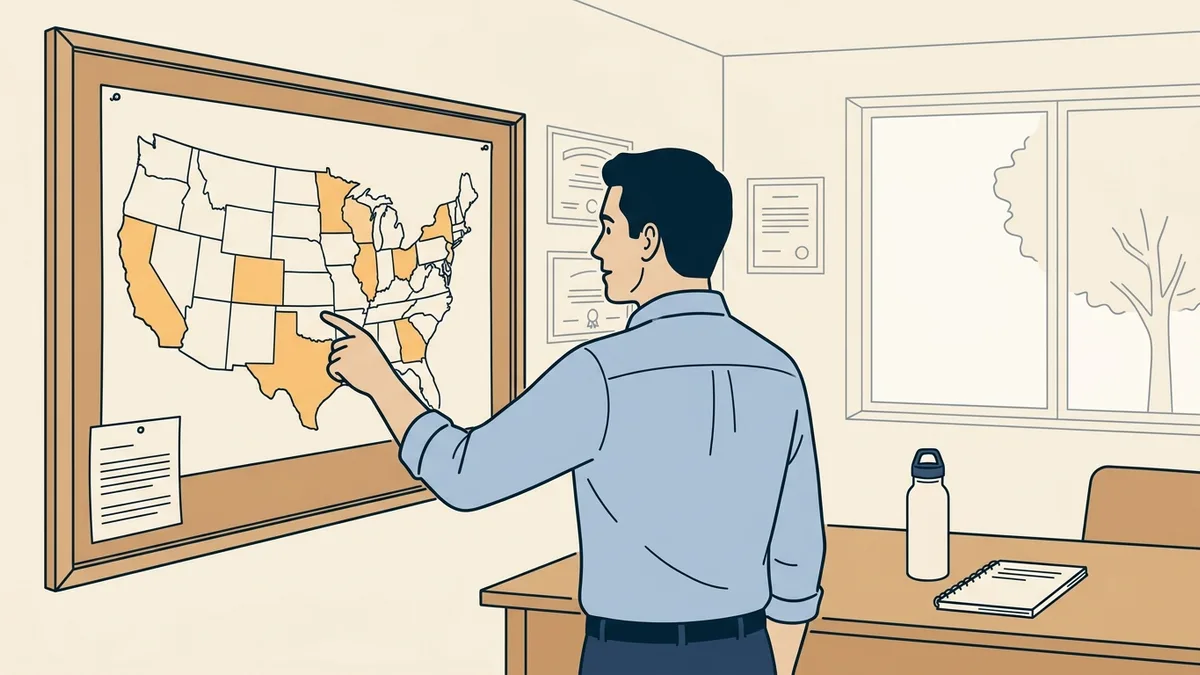
Nineteen states have enacted the Dietitian Licensure Compact: Alabama, Nebraska and Tennessee (2024); Arkansas, Iowa, Kansas, Mississippi, Montana, North Dakota, Ohio, Oklahoma, Rhode Island, South Dakota, Utah and Wisconsin (2025); and Georgia, Kentucky, Missouri and Washington (2026). None issues compact privileges yet.
Nineteen states have enacted the Dietitian Licensure Compact, according to the Council of State Governments (CSG) compact page as captured in September 2026. Enacting is the first step, not the last. No member state issues compact privileges yet, and the Commission on Dietetic Registration (CDR) expects the first ones sometime in 2027.
Which 19 states are members?
CSG lists each state with the year it joined:
- 2024 (3 states): Alabama, Nebraska, Tennessee.
- 2025 (12 states): Arkansas, Iowa, Kansas, Mississippi, Montana, North Dakota, Ohio, Oklahoma, Rhode Island, South Dakota, Utah, Wisconsin.
- 2026 (4 states): Georgia, Kentucky, Missouri, Washington.
The Commission's interactive map data, last published in May 2026, names the enacting bills. A few examples: Mississippi SB 2664, Ohio SB 211, Georgia HB 185, Kentucky HB 92, Missouri HB 2974 and Washington HB 2088. Tennessee passed matching bills in both chambers (SB 1862 and HB 1863), as did Alabama (SB 207 and HB 317) and Wisconsin (SB 71 and AB 45).
Not every page agrees on the count, because they were updated at different times. A March 2026 news post on the Commission's site says the compact "is now law in 16 states," and its State Commissioners page lists 15 commissioners, with none yet for Georgia, Kentucky, Missouri or Washington. The CSG list is the most recent of the three. Our compact hub tracks it.
Why did the seventh state matter?
The model law says the compact "shall come into effect on the date on which the Compact statute is enacted into law in the seventh Member State" (Model Compact § 12.A). Mississippi was the seventh. Its governor signed SB 2664 on March 21, 2025, joining Alabama, Tennessee, Ohio, North Dakota, South Dakota and Nebraska. Those seven are the charter members.
Activation started the Commission's work. It did not start privileges. In the Commission's words at the time, "dietitians cannot yet practice in other compact member states." That remains true in October 2026.
Does a member state issue privileges yet?
None does. The Commission's home page says compact privileges "are not yet being issued." Before any state can issue one, the Commission must adopt the rules that define the application process and fees, and a shared data system must be built and each state connected to it. The Commission has said states will onboard on "varying timelines," so the first state to open may be weeks or months ahead of the last. Our post on when privileges will start covers the remaining steps.
This is the point most often misread. A dietitian licensed in Ohio cannot see clients in Kansas on the strength of the compact today. Each state that requires a license still requires its own.
Where are bills still pending?
The Commission's map data lists two states with "Legislation Pending": Alaska (HB 340) and West Virginia (HB 4501). Both already license dietitians, so either could join if its bill passes. Every other non-member state appears on the map as having no active legislation. That map was last published in May 2026, so a bill introduced after that may not show.
Which states cannot join?
A member state must "License and regulate the Practice of Dietetics" (§ 3.A). The Commission's FAQ says California, Colorado, Virginia, Michigan and Arizona "would not be able to participate because they do not license or certify dietitians." California, Colorado and Virginia protect titles only. Arizona has no dietitian licensure law. Michigan has a statute, but the Academy of Nutrition and Dietetics' March 2026 telehealth chart says its regulations are not in effect "such that licensure cannot be granted." The same chart says the same of New Jersey, which the FAQ does not mention. See our post on states without a dietitian license.
How do the large states line up?
Of the eight large states we are asked about most (California, Texas, Florida, New York, Pennsylvania, Illinois, Ohio and Georgia), only Ohio and Georgia have joined.
- Ohio: member since 2025. Ohio's license is practice-exclusive, so a non-member resident still needs a full Ohio license to see Ohio clients. Ohio requirements.
- Georgia: member since 2026. Georgia requirements.
- Florida, Illinois, New York, Pennsylvania and Texas: no active compact legislation on the map.
- California: cannot join without first licensing or certifying dietitians.
Can I use the compact if I live outside these states?
No. The compact runs on your home state, defined as your "primary State of residence" (§ 2.O). A license from a member state you do not live in does not qualify. The model law says a single-state license granted to someone who does not live in a member state "shall not be recognized as granting a Compact Privilege" (§ 3.D). CDR says the same: if you live in a state without licensure, such as California or Arizona, or in a state that is not part of the compact, "you cannot use the Compact."
So a dietitian who lives in Texas and holds an Oklahoma license cannot use that Oklahoma license as a compact home license. They would keep relying on separate licenses in each client state. Our post on home state rules covers moves, military families and the one-home-state limit.
What should a dietitian in a member state do now?
Keep your home-state license active and unencumbered and your RD registration current. Those are the two things a future privilege will rest on. For clients in other states this year, you still need a license, certification or telehealth registration in each state that requires one.
We prepare those applications and track them; you review, sign, pay the board and submit. License by Endorsement is $599 per state, and a Multi-State Telehealth Package covers three states for $1,499. A Readiness Review ($149) tells you which of your client states you need and whether you will be compact-eligible later. Start with the state license index.
Common questions
- Is Texas in the Dietitian Compact?
- No. The Commission's map shows no active compact legislation in Texas. A dietitian who lives in Texas cannot use the compact, even with a license from a member state.
- Is California in the Dietitian Compact?
- No, and it cannot join as things stand. California protects dietitian titles but does not license or certify dietitians, and a member state must license and regulate the practice of dietetics.
- When did the Dietitian Compact become active?
- When Mississippi became the seventh state to enact it, with the governor's signature on March 21, 2025. Activation started the Commission's rulemaking. It did not start privileges.
- Which states have Dietitian Compact bills pending?
- The Commission's map data, last published in May 2026, lists Alaska HB 340 and West Virginia HB 4501 as pending.
Need Help with Your Application?
We prepare the dietitian licensing process end-to-end — eligibility screening, documents, board follow-ups, and tracking.